
Picking a bathroom vanity sounds simple until you're standing in your BTO toilet with a tape measure, realising the door swing eats into half the space you thought you had. A vanity is one of the few things you can legally change in your bathroom from day one of moving in, so it's worth getting right the first time.
This guide walks through the five things that actually decide whether a vanity works in a Singapore bathroom: size, HDB's renovation rules, material, mounting, and budget — in that order, because each one narrows down your options for the next.
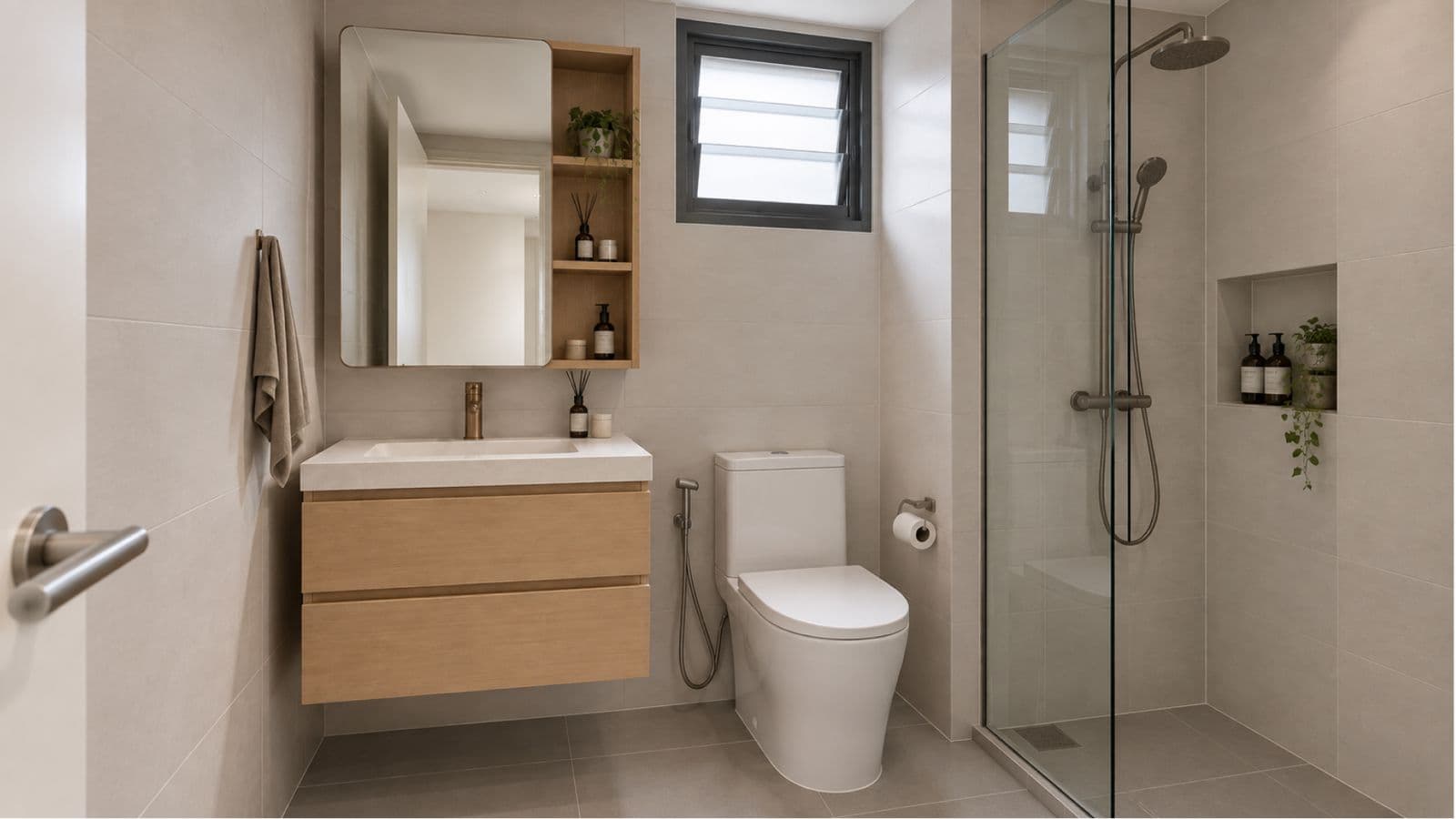
Step 1: Measure Your BTO Bathroom Before You Shop
Bathroom size varies a fair bit by flat type, and it's easy to overestimate how much space you actually have once the door swing and toilet clearance are accounted for.
Typical bathroom sizes by flat type:
3-room flat: unit around 60–65 sqm, bathroom usually 3–4 sqm
4-room flat: unit around 90–110 sqm, bathroom usually 4–5 sqm, often split into common and master bathroom
5-room flat: unit around 110–130 sqm, bathroom usually 5–6 sqm
These figures come from renovation contractors and property resources rather than an official HDB size chart, since HDB only publishes floor plans per block, not standardised toilet dimensions.
What to check on-site, in this order:
Door opening width. Common toilets in BTO flats typically have a rough opening of 700–750mm, master bathrooms slightly more at 750–800mm. Construction tolerances can shift this by 10–20mm, so always measure your own unit rather than assuming.
Door swing arc. This is the single most common measuring mistake. Homeowners frequently lose 8–12 inches of usable vanity width or depth simply because they measured wall-to-wall and forgot the door swings inward.
Clearance in front of the vanity. Building codes call for a minimum of about 533mm (21 inches) of clear floor space in front of a vanity, with 760mm (30 inches) as the comfortable recommendation.
Distance from toilet bowl centerline to vanity edge. Minimum 380mm (15 inches), recommended 450mm (18 inches), so cleaning and daily use don't feel cramped.
Floor loading, if you're considering a floor-standing unit. HDB slabs aren't rated for unlimited point loads, so a wall-hung vanity that transfers weight to the wall instead of the floor is worth considering for this reason alone, not just aesthetics.
Practical tip: tape out the vanity's footprint on your bathroom floor with masking tape and live with it for a day before ordering. It's the fastest way to catch a sizing mistake before it's expensive.

Do You Need an HDB Permit to Change Your Bathroom Vanity?
This is one of the most searched questions among new BTO owners, and the short answer is usually no — but the details matter.
HDB restricts homeowners from removing or altering the original floor and wall finishes in the bathroom and toilet for 3 years from the block's Temporary Occupation Permit (TOP) date. Since key collection typically happens 3–6 months after TOP, the restriction in practice usually runs about 2.5 years from the day you move in.
During this period, you generally cannot hack tiles, alter waterproofing membranes, or reconfigure plumbing without approval. What you can do is swap fittings, fixtures, and furniture — and a vanity cabinet falls into this category. Replacing a vanity is considered minor work as long as it doesn't involve hacking, moving water pipes, or breaking through the waterproofing layer.
If your renovation does go further than a straight swap, all bathroom work must be carried out by a contractor listed on HDB's Directory of Renovation Contractors, with plumbing done by a PUB Licensed Plumber and electrical work by a Licensed Electrical Worker. Unauthorised work can result in fines and a requirement to reinstate the flat at your own cost.
In short: a vanity is one of the very few bathroom upgrades you're free to make from the day you collect your keys, which is exactly why it's worth choosing a material that won't need replacing again in three years.
Step 2: Choose a Material That Can Handle Singapore's Humidity
This is the decision that determines how long your vanity actually lasts, and it's where most generic buying guides fall short — they're written for climates far drier than ours.
Why humidity matters more here than almost anywhere else. Singapore's average relative humidity sits around 82% year-round, based on over 40 years of data from the Meteorological Service Singapore (NEA) at Changi Climate Station. It's not seasonal — the pattern barely shifts month to month, which means your bathroom vanity is under sustained moisture stress for its entire service life, not just during a rainy season.
Building science research puts the risk threshold at 70% relative humidity — surfaces exposed above that level become prone to mould, corrosion, and moisture-related decay, according to Building Science Corporation. For wood-based materials specifically, the mechanism is clear: wood exposed to around 80% humidity gradually absorbs moisture until it reaches a 16% moisture content, which is the threshold where mould growth becomes likely. Singapore's baseline humidity already sits inside that risk zone before you even factor in a hot shower.
How common vanity materials hold up:
MDF (medium-density fibreboard): the most common budget option, and the most vulnerable. A single scratch or chip in the surface laminate lets moisture into the fibreboard core, which swells permanently once wet — the damage doesn't reverse.
Plywood: more moisture-resistant than MDF thanks to its cross-layered grain construction, which resists warping better. Still an organic material, so it's not immune to long-term humidity exposure, especially at exposed edges.
Solid wood: durable when properly sealed, but expensive, and still susceptible to swelling and joint loosening in consistently humid conditions.
PVC: a popular waterproof option because it doesn't absorb moisture the way wood-based boards do, though it's typically limited in finish and structural rigidity compared to metal.
Aluminium: doesn't contain iron, so it can't rust. On contact with air it forms a thin, naturally protective oxide layer, and doesn't swell, warp, or rot the way organic materials do.
Aluminium isn't invincible, though, and it's worth knowing where its limits are. Powder-coated or anodised aluminium resists corrosion well, but the protective layer can still be compromised by deep scratches, poor sealing, or galvanic corrosion — which happens when aluminium sits in direct, prolonged contact with a different metal (like an untreated steel bracket) in a damp environment. This is why the quality of the coating and the hardware used matters as much as the base material itself.
The real failure point for any bathroom cabinet isn't direct water contact — it's the constant cycle of hot and cold, humidity, and condensation over years. That's why cabinets that look fine when installed can warp, delaminate, or develop loose joints within 3–5 years in a humid bathroom, regardless of price.
If you want a deeper technical breakdown of aluminium vs. wood specifically, including how each holds up over a 5–10 year timeline, read our full comparison here.

Step 3: Pick a Style and Finish That Suits a Small Space
Once material is settled, style is mostly about proportion and light. In a compact BTO bathroom, lighter or reflective finishes tend to make the room feel less boxed in, while darker tones work well as a single accent rather than covering the whole vanity face.
Flat-panel doors give a clean, minimalist look that's easy to match with almost any bathroom tile or colour scheme — the safer choice if you're not planning to renovate again soon.
Fluted or textured panels add a hotel-style, designer feel, which has become a popular upgrade in newer BTO renovations.
Colour-wise, a warm cream or khaki finish tends to soften a small, tiled bathroom and pairs well with natural light, while a gun metal or dark grey finish reads more modern and works especially well in bathrooms with lighter tiles, where it becomes the visual anchor of the room.

Step 4: Decide on Storage and Mounting
Doors vs. drawers. Doors are more flexible for larger or oddly shaped items, while drawers make small toiletries easier to see and grab — genuinely useful in a shared common bathroom where mornings move fast.
Wall-hung (floating) vs. floor-standing. For a bathroom under 4 sqm, a wall-hung vanity is usually the better call for three reasons: it keeps the floor visually and physically open, it makes cleaning underneath far easier, and it shifts the weight load onto the wall instead of the floor slab.
That last point comes with a real requirement, though. A wall-hung vanity needs to be mounted on a solid wall — concrete or brick — using anchors rated for the combined weight of the cabinet, basin, and water. Installing into hollow partition walls or standard drywall isn't safe for this kind of load. If your bathroom wall is tiled, drilling also needs to go through the tile without cracking it and without compromising the waterproofing membrane behind it, which is a good reason to have this done by an experienced installer rather than as a DIY job.
Step 5: Set a Realistic Budget
Vanity pricing in Singapore typically breaks down by tier (more or less):
Entry-level (modular, MDF/particleboard): roughly S$450–S$850 all-in for a standard 600mm unit, including basic fixtures
Mid-range (solid plywood or better hardware): roughly S$1,400–S$2,500
Premium (aluminium or fully custom): S$2,800 and up, depending on size, countertop material, and customisation
The cheapest option upfront isn't always the cheapest over time. A vanity that needs replacing in 3–5 years because the material couldn't handle the humidity ends up costing more than a slightly pricier one that lasts a decade. When comparing quotes, always check whether installation, basin, tap, and waste trap are included, since these are commonly quoted separately and can shift the final price significantly.
Common Mistakes to Avoid
Measuring width but not depth or door swing — the most common reason a vanity doesn't fit as expected
Choosing based on looks alone, without checking whether the material suits a consistently humid bathroom
Assuming a wall-hung vanity can go on any wall — it needs a solid concrete or brick surface, not a hollow partition
Skipping the HDB 3-year rule check if your renovation involves more than a straight vanity swap
Underestimating storage needs for a shared common bathroom versus a single-user master bathroom
FAQ
Do I need a permit to replace my bathroom vanity in a BTO flat? No, in most cases. A straight vanity replacement that doesn't involve hacking tiles, moving plumbing, or altering waterproofing is considered minor work and doesn't require a permit, even within the 3-year restriction period.
What is the best vanity size for a BTO common bathroom? Most BTO common bathrooms fit a vanity between 500mm and 600mm wide comfortably, while master bathrooms can usually accommodate 600mm to 700mm or more. Always confirm against your own measured clearance rather than a general guideline.
Is an aluminium vanity better than PVC or wood for a BTO bathroom? Aluminium doesn't rust, swell, or warp the way wood-based materials can, and it holds up well against Singapore's year-round humidity. PVC is also waterproof but generally more limited in finish and structural rigidity. The trade-off is a slightly higher upfront cost for aluminium, offset by lower long-term maintenance and replacement costs.
Can I install a wall-hung vanity in an HDB bathroom? Yes, as long as it's mounted on a solid concrete or brick wall with anchors rated for the combined weight of the cabinet, basin, and water. It shouldn't be installed on a hollow partition wall.
How long does a good bathroom vanity last in a humid climate? This depends heavily on material. MDF-based cabinets often show swelling or delamination within 3–5 years in a humid bathroom, while plywood lasts longer with proper sealing. Aluminium cabinets are built to resist warping, rust, and moisture damage over a much longer service life.
If you're renovating a BTO bathroom and want a vanity that's actually built for Singapore's humidity, Las Vela's aluminium vanities are designed exactly for this: waterproof, rust-resistant, and available in sizes that fit both common and master BTO bathrooms.
Compact common bathroom option: Vanity Cabinet Y32 — wall-hung, 620 x 480 x 420mm
Most popular size: Vanity Set Y-40 — available in 500mm, 600mm, and 700mm widths
Fully custom sizing and finishes: Bespoke Vanity