
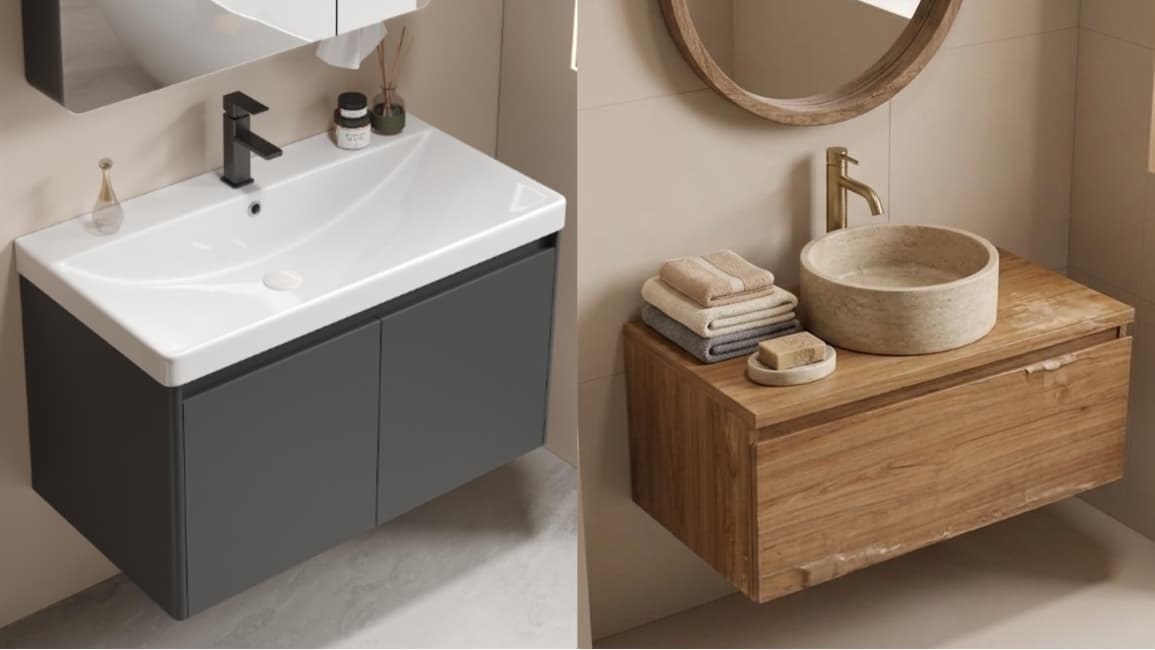
Quick answer: Aluminum vanities last 15 to 20 years in Singapore's bathrooms. Wood vanities, including plywood and MDF, typically last 5 to 10 years before swelling, warping, or mold sets in. The gap comes down to one number: Singapore's bathrooms sit at 82% average humidity year-round, well past the point where organic materials start to fail.
If you're comparing aluminum and wood vanities for an HDB, condo, or landed bathroom, the material you choose decides how many times you'll be doing this again. Wood looks warmer on day one. Aluminum is still standing in year fifteen. Here's what actually separates them, with the numbers to back it up.
Why Singapore's Humidity Wears Down Bathroom Vanities Faster
Singapore's mean annual relative humidity sits at around 82%, according to the National Environment Agency. It climbs past 90% in the early morning and rarely drops below 60% even on dry afternoons.
Mold research from ScienceDirect puts the growth threshold at 60% relative humidity in poorly ventilated rooms, and 70% in well-ventilated ones. Singapore's baseline sits above both marks, every day of the year. This isn't a wet-season problem. It's the permanent condition inside most local bathrooms.
HDB common bathrooms make this worse. Many don't have a window at all, relying entirely on an exhaust fan or shared ventilation shaft. NEA's Code of Practice on Environmental Health sets a minimum of 15 air changes per hour for mechanically ventilated toilets. Older flats with a small or aging exhaust fan often fall short of that, which traps humidity against the vanity for longer stretches each day.
HDB's own renovation rules reflect how seriously the authority treats bathroom moisture. Waterproofing membranes must run at least 150mm up the walls and cover a 400mm radius around the sanitary stack. Your bathroom is built as a wet zone from the ground up. The vanity sitting inside it should be built the same way.

Aluminum vs Wood Vanity: Lifespan Year by Year
Here's how each material actually holds up over time, not just at the point of purchase.
Aluminum vanity, by year:
Year 1 to 2: No visible change. A thin oxide layer forms on the surface the moment it meets air or moisture.
Year 3 to 5: Still no swelling or warping. Hardware may need a soft-close hinge check.
Year 5 to 10: Finish stays intact. Scratches self-heal at the surface level since the oxide layer reforms almost instantly when damaged.
Year 10 to 20: Structurally sound. Most units are still in daily use with only cosmetic wear from impact.
Wood, plywood, or MDF vanity, by year:
Year 1 to 2: Fine if the sealant holds and the bathroom is well ventilated.
Year 3 to 5: First signs of trouble at joints and edges. Sealant wears thin from daily splashes.
Year 5 to 10: Swelling and softening become visible, especially at the base and around the sink cutout. Once MDF or particleboard absorbs water, the swelling is largely permanent, according to peer-reviewed testing published in PMC. Solid wood recovers a little if dried quickly. Engineered wood does not.
Year 10 and beyond: Full replacement is typical unless the material was marine-grade and maintained closely.
A BioResources study from NC State University measured what repeated humidity cycling does to wood-based panels. After nine cycles, MDF's thickness swelling increased by nearly 32%. Particleboard rose 23.7%. Both changes stuck. That's the mechanism behind every "warped vanity door" complaint you've seen on forums.
Industry lifespan data from the NAHB's Study of Life Expectancy of Home Components shows wood building components ranging from 10 years under constant moisture to 100 years in a dry, well-maintained climate. That 10x spread shows how much humidity alone can shrink a wood product's usable life. A Singapore bathroom sitting at 82% humidity puts wood vanities at the short end of that range by default.

Aluminum vs Solid Hardwood Vanity
Solid hardwood is the strongest wood option on the market, and it's worth separating from MDF or particleboard because the comparison changes.
Solid teak or oak resists moisture better than engineered wood and can last 15 to 20 years in a dry climate. The catch is that figure assumes a dry climate. In an 82% humidity bathroom without strong ventilation, even solid hardwood needs regular resealing to hold that lifespan, and a missed maintenance cycle shortens it fast.
Aluminum needs none of that upkeep. There's no sealant to reapply, no wood grain to protect, no annual inspection for early swelling. For homeowners who want a set-and-forget material, aluminum wins on maintenance alone, even against the best wood option available.
Where solid hardwood still has an edge: the natural grain and warmth are hard to replicate in metal. Powder-coated aluminum now comes in woodgrain-style finishes that get close, but a purist will still spot the difference up close.
Aluminum vs Engineered Wood (MDF and Plywood) Vanity
This is the comparison that matters most, since MDF and plywood make up most of the budget and mid-range vanities sold in Singapore.
Engineered wood swells faster and doesn't recover. The BioResources data above applies directly here: once MDF absorbs moisture from repeated splashing or steam, the swelling stays. Doors stop closing flush. Edges start to peel at the laminate seams. This typically shows up within 3 to 5 years in a humid bathroom, sometimes sooner if the sealant was applied unevenly at the factory.
Aluminum doesn't have this failure point at all. There's no core material to absorb water, so there's no swelling to track. The tradeoff is upfront cost. Aluminum vanities run 20 to 30% higher at purchase than a comparable MDF unit. Over a 10 to 15 year horizon, that gap closes and usually reverses once you factor in replacement cycles.

The Real Cost Over Time: Aluminum vs Wood
A cheaper vanity today isn't cheaper if you're replacing it twice before the aluminum one needs anything.
MDF or budget wood vanity:
Lower purchase price
Typical lifespan of 5 to 10 years in a humid bathroom
Repair or replacement needed at least once within a 15-year window
Added cost: labor for removal, disposal, and reinstallation each time
Aluminum vanity:
Higher purchase price, roughly 20 to 30% more upfront
Typical lifespan of 15 to 20 years
No mid-cycle replacement in most cases
Maintenance limited to wiping down with a damp cloth
Run the math over 15 years and the wood vanity's "savings" often gets absorbed by one full replacement, plus the hassle of coordinating removal and reinstallation around a bathroom you're still using every day. Aluminum's higher entry price buys you out of that cycle entirely.
When Wood Still Makes Sense
Aluminum isn't the only right answer for every bathroom, and a one-sided pitch wouldn't serve you well here.
Wood still makes sense if your bathroom has strong natural ventilation, a window that stays open, and you're committed to resealing on schedule. It also suits homeowners prioritizing a specific aesthetic, like a warm Scandinavian or Japandi look where the grain itself is the design statement. If you're renovating a guest powder room with light use and good airflow, the humidity stress that breaks vanities in a daily-use HDB bathroom simply won't apply the same way.
The honest tradeoff: wood asks for more attention from you in exchange for a look aluminum can only approximate. If you're willing to maintain it, it can hold up reasonably well outside a wet, poorly ventilated bathroom.
Signs Your Current Vanity Is Already Failing
If you're not sure whether it's time to replace, check for these:
Doors that stick or don't close flush. This usually means the panel has already swollen at the edges.
Soft or spongy spots near the base or around the sink cutout, a sign moisture has reached the core material.
Peeling laminate or bubbling at the seams, especially where the countertop meets the cabinet.
A musty smell that doesn't go away after cleaning, which often points to mold growing inside the cabinet rather than on the surface.
Visible gaps at the joints where sealant has worn away, letting water in with every use.
Any one of these on its own is worth watching. Two or more together usually means the material has already passed the point of resealing or spot repair.

Frequently Asked Questions
Is aluminum better than wood for a bathroom vanity in Singapore? For daily-use bathrooms with typical Singapore humidity, yes. Aluminum resists water, rust, and pests without the maintenance wood requires, and it lasts roughly twice as long in most cases.
How long does an aluminum vanity last in an HDB bathroom? Most aluminum vanities last 15 to 20 years in HDB conditions, based on the material's resistance to swelling, corrosion, and pest damage.
Will an aluminum vanity rust over time? No. Aluminum forms a natural oxide layer on contact with air or water. This layer is self-healing, so even a scratch doesn't expose the metal to ongoing corrosion.
Is a wood vanity a bad choice for a humid bathroom? Not automatically, but it needs more from you. Solid hardwood with regular resealing can hold up reasonably well. MDF and particleboard, the most common budget materials, swell within a few years without careful ventilation and maintenance.
How much does an aluminum bathroom vanity cost in Singapore? Pricing depends on size and finish. Las Vela's current bespoke packages start from S$1,350 for a common bathroom set and S$1,980 for a master bathroom set, both built from aluminum honeycomb panels with a sintered stone countertop.
Do aluminum vanities work for HDB bathroom sizes? Yes. Standard aluminum vanity dimensions are built to fit HDB, condo, and landed bathroom layouts, and custom sizing is available where the standard package doesn't match your floor plan.
Choosing a Vanity That's Built for Singapore's Climate
The material question comes down to how much attention you want to give your vanity after installation. Wood asks for regular upkeep to hold up against 82% average humidity. Aluminum is built to handle it without that ongoing effort.
If you're renovating and want a vanity that's waterproof, rust-resistant, and termite-proof from day one, Las Vela's bespoke aluminum vanity comes with a sintered stone countertop, soft-close hinges, and sizing built around HDB and condo bathrooms. Read more on why aluminum vanities suit Singapore homes, or reach out on WhatsApp to check sizing for your bathroom.